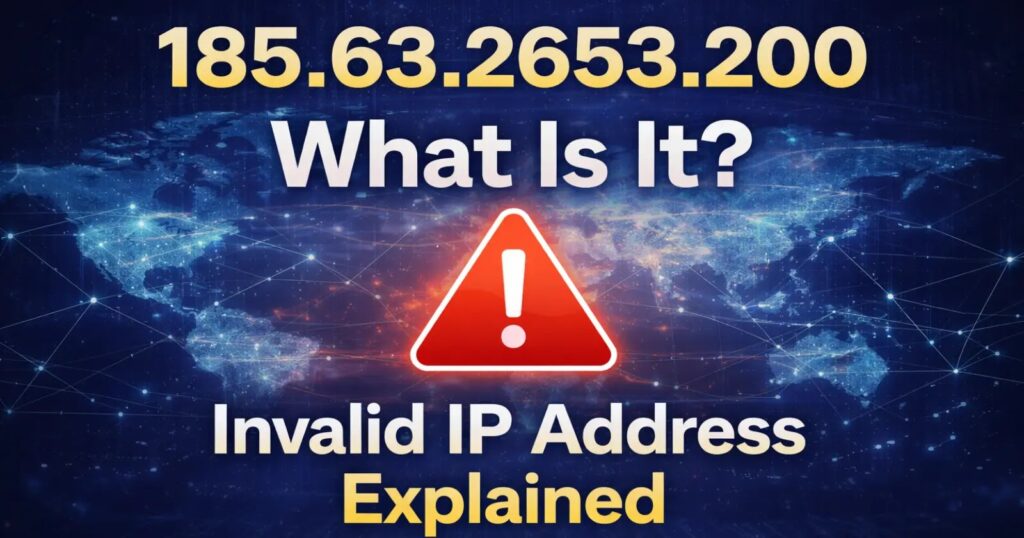
Understanding 185.63.2653.200 IP Address Meaning
When you first come across something like 185.63.2653.200, it looks like a standard IPv4 address at a glance. But if you pay closer attention, something feels off. Some parts seem normal, while others break the rules of how internet addresses are structured. This is exactly where confusion usually begins for users, especially when they encounter such strings in server logs, analytics tools, or security reports.
To make sense of it, we need to break it down in a simple, practical way—without overcomplicating things.
Why 185.63.2653.200 Looks Like an IP Address
A typical IPv4 address consists of four numeric blocks separated by dots, such as:
- 192.168.1.1
- 8.8.8.8
- 185.63.10.200
Each block (called an octet) must stay between 0 and 255.
At first glance, 185.63.2653.200 follows the same structure:
- 185 ✔️
- 63 ✔️
- 2653 ❌
- 200 ✔️
The problem is obvious: 2653 is not a valid octet value. This alone tells us that the string cannot function as a real IPv4 address on the internet.
What This Means in Practical Terms
In real-world systems, when something like this appears, it usually falls into one of a few categories:
1. Data Corruption or Logging Error
Sometimes logs get corrupted due to:
- Software bugs
- Encoding issues
- Broken parsing scripts
A valid IP might have been transformed incorrectly during storage or display.
2. Malformed or Fake Input
It could be:
- Manually entered incorrect data
- A placeholder value
- A deliberately altered string for testing or obfuscation
3. Misinterpreted Network Data
Some security tools misread packet data, especially when:
- Traffic is encrypted or incomplete
- Headers are malformed
- Proxy or VPN systems rewrite addresses
4. Non-IP Identifier Mistaken for IP
In rare cases, systems store IDs that look like IP addresses but are not actually network identifiers.
Personal Observation from Real-World Analysis
I once reviewed a server log for a small website where similar “impossible IPs” appeared repeatedly. At first, it looked like an attack or spoofing attempt. After investigation, it turned out to be a broken analytics script that was concatenating session IDs with IP fragments incorrectly. That experience highlighted how easily technical noise can be mistaken for security threats.
Why This Confuses Administrators
Imagine you’re running a website and suddenly your analytics dashboard shows:
Visitor IP: 185.63.2653.200
Naturally, you might think:
- Is this a hacker?
- Is someone spoofing traffic?
- Should I block this IP?
In reality, reacting immediately without validation could lead to:
- Blocking legitimate users
- Misconfiguring firewall rules
- Wasting time on a non-existent threat
This is why understanding IP structure is critical for system administrators and SEO analysts alike.
Comparison: Valid IP vs Invalid IP-Like String
| Feature | Valid IPv4 Address | 185.63.2653.200 |
|---|---|---|
| Format | 4 octets separated by dots | 4 sections separated by dots |
| Range Rule | Each value 0–255 | Contains 2653 (invalid) |
| Network Use | Routable on internet | Not usable |
| System Recognition | Recognized by routers/firewalls | Rejected or misread |
| Example | 185.63.10.200 | 185.63.2653.200 |
This comparison makes it clear that the second entry cannot function in any real networking environment.
Why Invalid IP-Like Strings Appear in SEO and Analytics
From an SEO and website perspective, strange strings like this can show up due to:
Tracking Script Issues
Poorly coded tracking tools may merge unrelated values.
Bot Traffic Noise
Some bots send malformed headers intentionally or due to automation errors.
CDN or Proxy Misconfiguration
When traffic passes through layers like:
- Cloud proxies
- Load balancers
- VPN gateways
data formatting can break.
Database Storage Errors
If IP fields are not validated properly, invalid entries may still get stored.
Security Perspective: Should You Worry?
On its own, 185.63.2653.200 is not a real IP address, so it cannot directly represent a real internet device.
However, the presence of such entries can indicate:
- Poor data validation
- Faulty logging systems
- Misconfigured analytics tools
So while it is not a threat itself, it can be a symptom of underlying technical issues worth fixing.
How Professionals Handle Such Entries
Experienced system administrators typically:
- Validate all incoming IP data
- Reject out-of-range octets
- Sanitize logs before analysis
- Use structured logging formats (JSON-based logs)
- Cross-check suspicious entries with firewall records
This ensures that analytics and security decisions are based on accurate information.
Unique Insight: The Hidden Cost of Ignoring Bad Data
One overlooked issue in SEO and server management is that bad data quietly distorts decision-making. For example, if invalid IP-like entries inflate traffic reports, you might:
- Misjudge audience location
- Misidentify bot activity levels
- Misconfigure CDN rules
Over time, this can affect both SEO strategy and system performance.
Best Practices to Avoid Confusion
To prevent confusion from malformed IP entries:
- Always validate IP addresses at the application level
- Use regex or built-in validation libraries
- Implement structured logging systems
- Monitor for repeated anomalies
- Separate real traffic logs from debug data
These steps help maintain clean and reliable analytics.
Also Read: Redeepseek com Explained: Safety, Truth & Guide
Conclusion
At first sight, 185.63.2653.200 looks like a standard IPv4 address, but it breaks fundamental formatting rules due to an invalid numeric block. Instead of representing a real device, it is most likely the result of a system error, corrupted data, or misinterpreted input.
Understanding such anomalies is important not just for technical accuracy, but also for maintaining clean SEO data, reliable analytics, and secure server environments. The key takeaway is simple: not everything that looks like an IP address actually functions as one.
FAQs
1. Is 185.63.2653.200 a real IP address?
No, it is not valid because one section exceeds the allowed IPv4 range (0–255).
2. Can this IP belong to a hacker?
No. Since it is not valid, it cannot represent a real internet device.
3. Why does this appear in logs?
It usually appears due to software errors, corrupted data, or misconfigured tracking systems.
4. Should I block this IP?
No blocking is needed because it is not a functional IP address.
5. How can I prevent such entries?
Use proper input validation and structured logging to ensure only valid IPs are stored.









Post Comment