



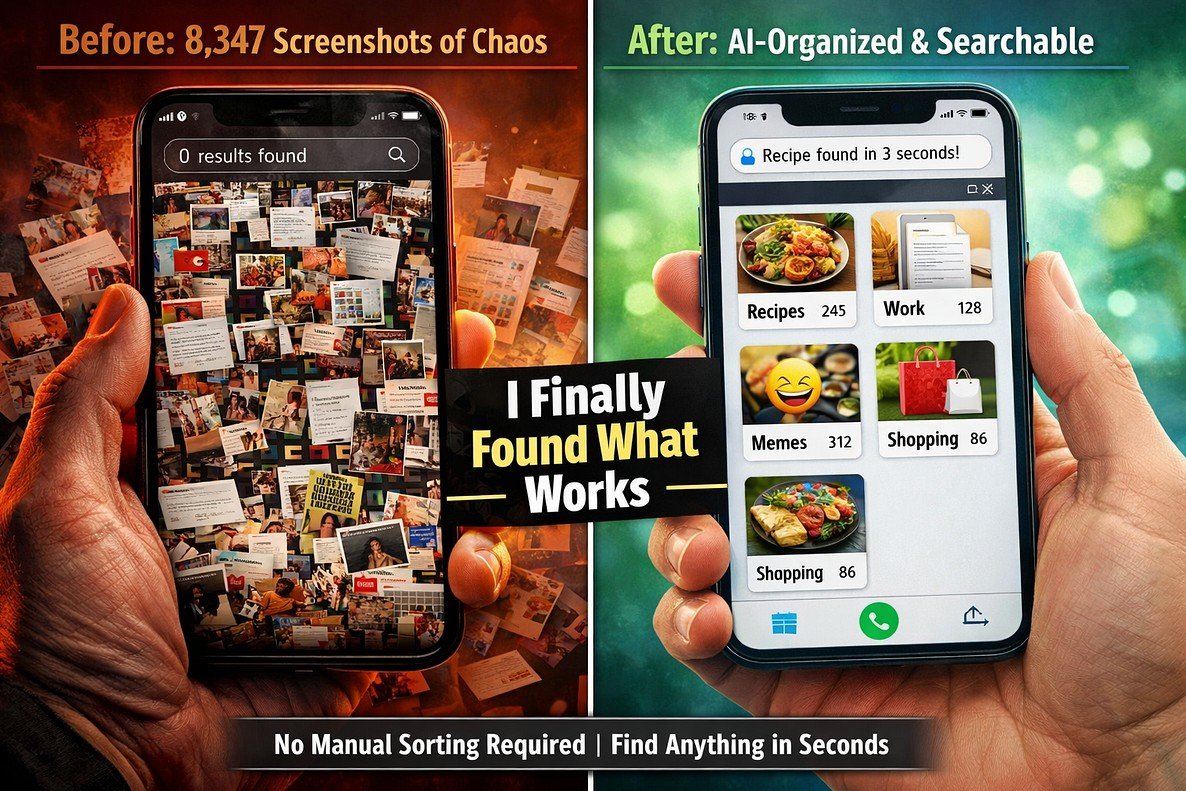
The quickest way to tidy my camera roll is to ignore my photographs. Screenshots of expired notices and half-forgotten plans are easier to judge than pictures of people, where deleting one can feel oddly personal. I open the Screenshots album first instead of attempting a chronological cleanout of the whole gallery.
A camera roll mixes a photo from someone’s birthday with a parking sign, a recipe and a blurry picture of a shelf label. Sorting by date makes me consider all of them together. Screenshots give me a smaller pile with more obvious answers.
Screenshots Make the First Pass Easier
Open the Screenshots album and look at the newest few rows, rather than scrolling back through camera photos by date. You can usually tell why you saved a screenshot from what is on it: an opening time, a booking detail, a message you meant to answer. That makes the first decision fairly small. Do I still need this information?
I once found a parcel tracking screen long after the parcel had arrived. There was nothing to file or remember. The delivery had settled the question on the screen, and the image had stayed only because I had forgotten it was there. Plenty of screenshots have that sort of clear end, which is more than I can say for a photograph of an ordinary afternoon with friends.
A kettle boiling gives you enough time to review a small batch. Delete the obvious leftovers, leave anything uncertain like a screenshot of a big win at Candy Land Casino and stop when the water is ready. You can make progress without promising yourself a whole evening or deciding where every image on the phone belongs.
Leisure Captures Need Limits
Set a timer before checking screenshots saved for later entertainment. I use around ten minutes for this pass because looking up one show title can easily become browsing trailers and reading descriptions. The timer is for sorting the images, not for finishing every choice they bring to mind.
For example, a time-boxed session at Candy Land, an online casino, is paid entertainment alongside streaming and mobile games, with a spending budget set in advance like a cinema ticket. A screenshot from any leisure app deserves the same plain question: is there something to move to a better place, or has the moment passed? Those two answers cover most of the captures I run across.
Watch Ideas Need a Proper Home
If a streaming screenshot contains a show I still want to see, I add the title to the app’s watchlist and then delete the image. A watchlist is easier to find when I sit down to watch something; a screenshot can disappear beneath weeks of receipts and directions. Keeping both usually gives me two places to forget the same suggestion.
I check the release year when a screenshot shows two versions with the same title. Typing a title alone into a watchlist can lead me to the wrong film or series later. Once the right version is saved, the screenshot has done its job.
Passing Moments Can Expire
Some captures only helped with a conversation or a particular outing. I give those a quick look for dates or details I still need, then clear them. The decisions tend to be simple:
- Delete a friend’s mobile game score after sending your reply.
- Delete a concert poster after putting its date and venue in the calendar.
- Delete a venue bag-policy screen after the visit, instead of leaving it among holiday photos.
The concert poster is the one I would pause over. If tickets are still to go on sale, I put a calendar reminder in as well as the event details. That leaves the useful prompt where I will see it on time, rather than relying on a picture I may never open again.
Some Screenshots Deserve More Time
Keep anything you may need to prove what happened. A return label or QR code stays until the refund has appeared, even if the parcel has already been dropped off. The handover receipt and the money arriving are separate moments, and the screenshot may still help if the return needs chasing.
I treat a screenshot documenting a billing dispute the same way. A confirmation screen showing what was charged or what a company said is different from an expired advert. I leave it alone until the issue is resolved, then decide whether the image still has a purpose. Quick sorting works best when “keep for now” is an acceptable answer.
There is also a reason to look closely before involving someone else in a cleanup. A screenshot may show an address, an account detail or a code in the corner. If I am sending an image to a friend to ask what it was for, I check the whole screen first. Deleting can wait a minute; sharing a private detail is harder to undo.
Small Start Is Enough
Stop after one manageable batch, even if the rest of the Screenshots album still looks untidy. The aim is to remove images whose purpose has ended, not to turn a spare ten minutes into a filing project. Family pictures and other difficult choices can have their own session on another day.
Screenshots cover only part of my mess. Sorting them first makes the gallery feel approachable without forcing a decision about every photograph.
