



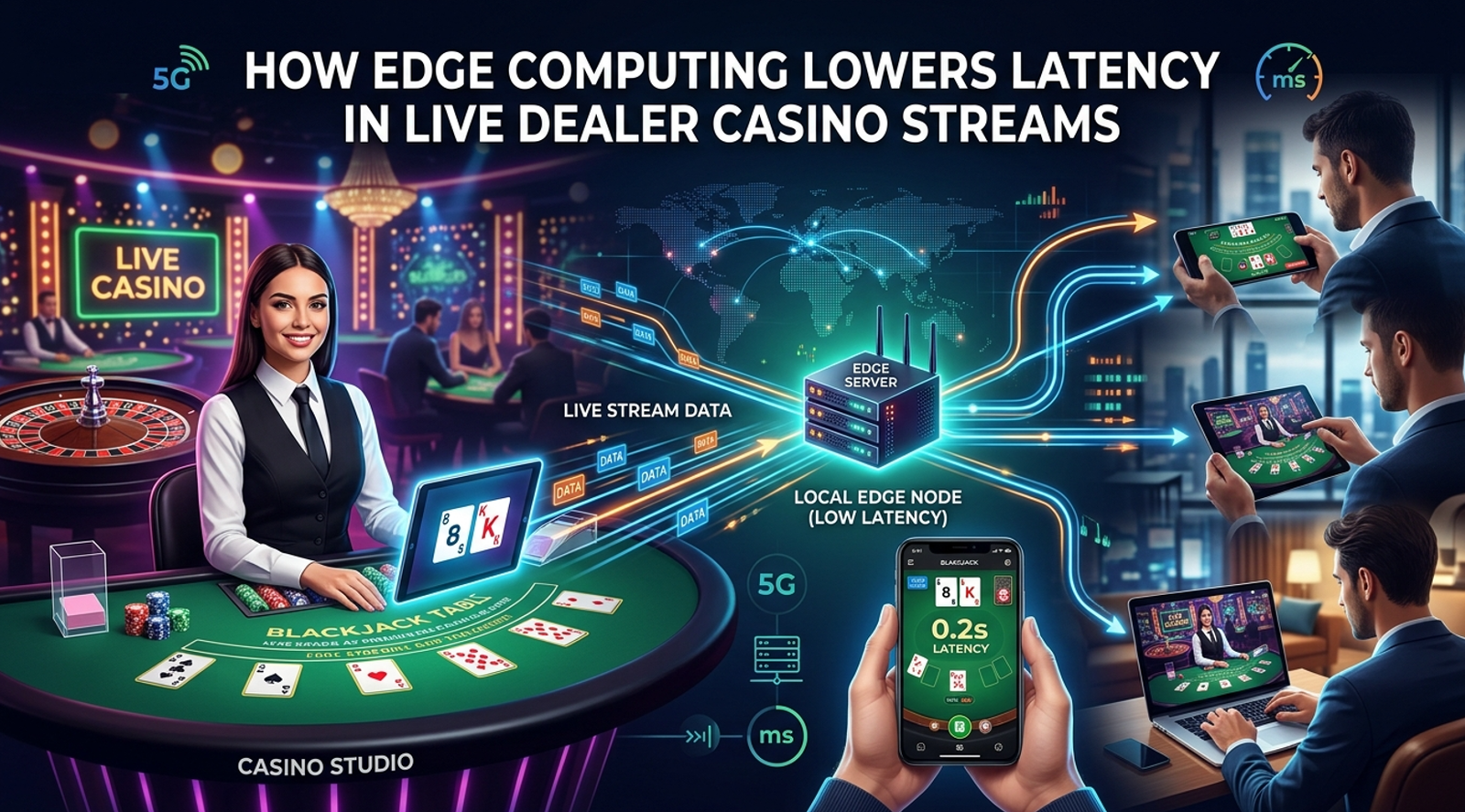
Edge computing lowers latency in live dealer casino streams by processing video and bets near the player instead of a faraway cloud. That shorter path cuts round-trip time, so the camera, the betting window, and chat stay in sync. For live blackjack, roulette, and baccarat, that difference is the gap between a fair table and a delayed one.
Why Live Dealer Streams Can’t Wait on a Distant Cloud
When a live dealer flips a card or spins a wheel, the video and the betting window have to stay in sync. That is the product players look for on sites such as Emiratian Casino, which list sites that feature live blackjack, roulette, baccarat, and other real-time dealer tables. A distant cloud data center adds extra network hops. Those hops slow the picture, the bet confirmation, and dealer chat at the same time.
A live table is not a TV show. You place a wager against a clock. If the stream is two seconds late, you may still see a sharp 1080p dealer and still miss the last chip. If one player’s feed is faster than another’s, the table also starts to feel unfair, even when the studio game is honest.
What Edge Computing Changes
Edge computing puts servers, caches, and small bits of code closer to you: in a city point of presence (PoP), a content delivery network (CDN) node, or a mobile edge site near a 5G tower. That last setup is often called multi-access edge computing, or MEC. Your phone or laptop then talks to a nearby node instead of a studio-region origin thousands of miles away. That cuts:
- Round-trip time (RTT)
- TLS handshake delay on first connect
- Jitter from long internet paths
- Load on the origin encoder and game server
It does not shrink every delay. Camera capture, video encoding, packaging, and the player buffer still take time. Edge mainly shrinks the network slice of the trip. Light in fiber is fast, but not instant. An ocean hop can add about 80 to 120 milliseconds of RTT. The same viewer hitting a local PoP may see 5 to 20 milliseconds. On a WebRTC live table, that saved hop is a large share of the whole budget. On old HLS streaming with six-second segments, it barely moves the needle.
The Two Clocks that Make or Break a Live Table
Most explainers treat latency as one number. Live dealer play has two clocks.
- Glass-to-glass video. Time from the studio camera to your screen.
- Wagering round trip. Time for your bet, hit, or spin command to reach the game engine and come back as a confirmed state.
If the casino puts the video on an edge CDN but still sends every chip to a far origin, you will see the dealer in near real time and still watch your bet land late. The stream feels live. The table does not. This is why edge compute, not only edge cache, is important. Nearby nodes can:
- Steer you to the closest selective forwarding unit (SFU) for WebRTC
- Transcode H.264 or H.265 to match your bandwidth
- Validate a session token without a long origin call
- Keep game-state messages on a short UDP or WebRTC data-channel path
Optical character recognition (OCR) and table sensors in the studio still run at the source. Edge does not see the cards first. It just gets the result to you with fewer extra hops.
Protocol Choice Still Beats a Fancy Map of PoPs
Edge helps. The protocol sets the floor.
- Standard HLS / DASH: 10 to 30 seconds. Fine for TV. Too slow for betting.
- Low-latency HLS (LL-HLS): about 2 to 4 seconds. Watchable, still late for last-second chips.
- WebRTC (often via an SFU): about 200 to 800 ms. Some casino stacks target under 250 ms. This is the real-time tier.
If the packager still waits on long groups of pictures (GOP), or the player buffers three big segments, no CDN map will save the round. Casinos that want sub-second tables need WebRTC or a similar real-time path, then place SFUs at the edge so each region has a short last mile. Adaptive bitrate (ABR) still belongs in the stack. A stable 720p stream that stays in sync beats a 4K stream that freezes, rolls back, and then races to catch up.
Fair Play is a Latency Problem too
Low lag is not only comfort. It is trust.
- Shared clock: Every seat should see the same card at nearly the same moment.
- Betting window: The timer on screen must match the studio clock, not a delayed buffer.
- Chat: A dealer reply that arrives a second late feels scripted.
- Mobile 5G: Radio latency can drop versus 4G, but only if the game server is also nearby. Fast 5G to a far cloud is still a long trip.
A delayed feed can look like a tipped table even when the shoe is clean. Edge routing plus a real-time protocol keeps players in the same moment as the cards, the wheel, and the host.
What You Can Check in a Real Session
You do not need a lab. In a live blackjack or roulette seat, watch for:
- The bet timer and the dealer’s hands moving together
- Chat that answers in the same breath
- No freeze, then a sudden jump of several cards
- Similar delay on phone and desktop on the same network
If the picture is sharp but chips confirm late, the video path is fine and the game path is not. That is a backend placement problem, not “your Wi-Fi.” A wired connection or strong 5G still helps. Packet loss forces extra buffering. Edge nodes can’t fix a congested last mile inside your building.
Final Words
Edge computing lowers live dealer latency by moving delivery, transcoding, and often the bet path closer to the player. Pair that with WebRTC, a short player buffer, and a nearby SFU, and the table stops behaving like delayed TV. Leave the video on the edge and the wagers in a far cloud, and you still lose the last second that matters.
